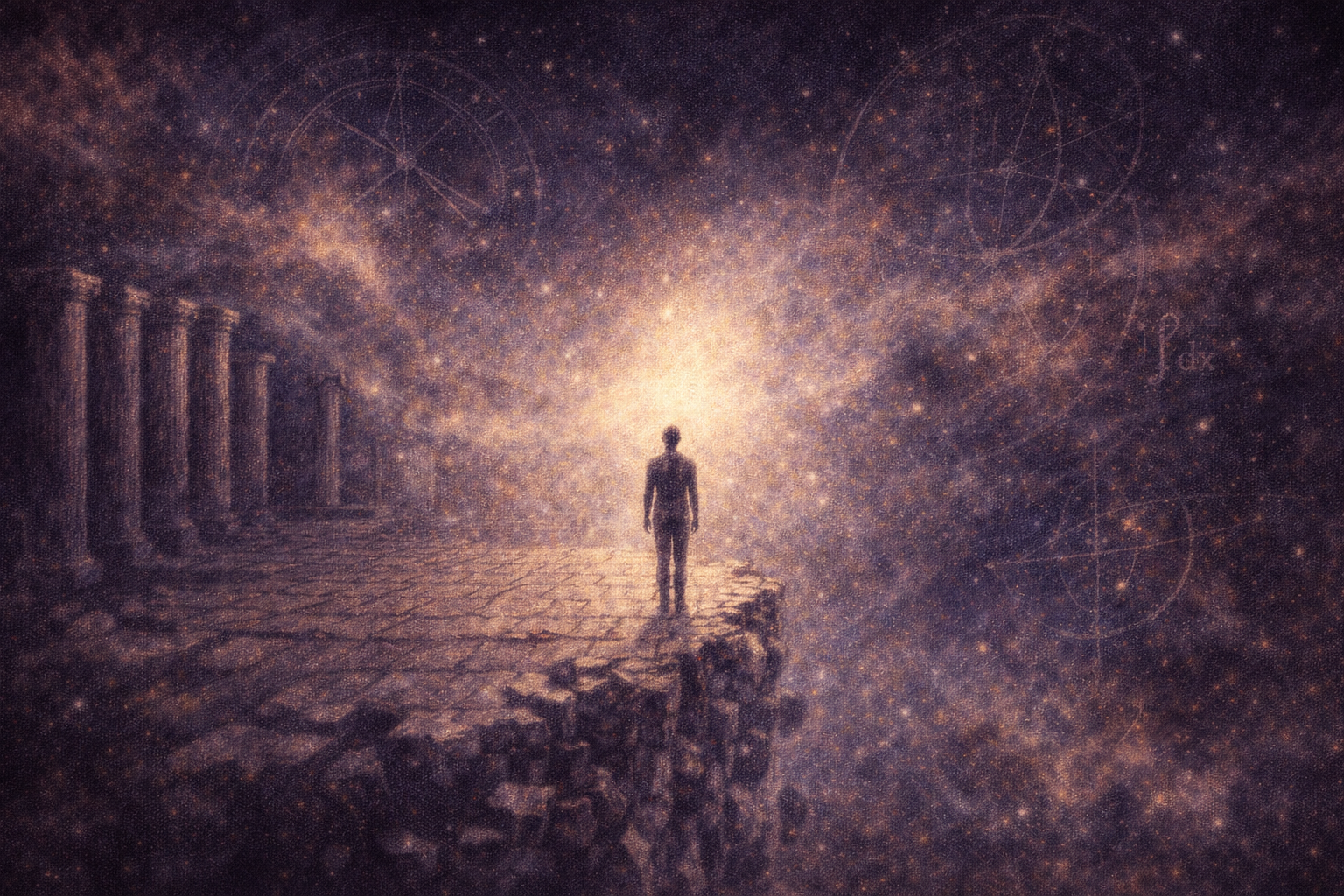
If we remove belief, tradition, and emotion—what can reason actually say about why we exist?
Introduction
The question has always been there.
Sometimes loud.
Sometimes quiet.
But never completely gone.
Why do I exist?
Not:
- What should I do?
- What is my purpose?
- How should I live?
But something more fundamental.
Why is there:
anything at all… instead of nothing?
The First Assumption
Most answers begin too quickly.
Religion says:
- You were created for a purpose
Philosophy says:
- You construct your own meaning
Society says:
- You exist to achieve, contribute, succeed
But all of these share something:
They assume:
existence already makes sense
They skip the deeper question.
Removing Assumptions
So I tried something different.
Remove everything:
- belief
- culture
- emotional comfort
- inherited meaning
And ask:
What can reason alone say?
The Fact of Existence
The first undeniable observation:
Existence is happening
Not as a theory.
As a fact.
Something is:
- present
- experienced
- known
This cannot be denied without using it.
The Impossibility of Nothing
Then comes a strange realization.
We can imagine “nothing.”
But we cannot:
experience nothing
Even the idea of nothing:
- appears in awareness
- exists as a concept
So from a rational perspective:
Nothing cannot be observed
Which makes existence:
the only observable condition
Cause and Origin
Then comes the question:
What caused existence?
Every cause:
- must exist
So if you trace back causes…
You never reach:
non-existence
You only move within:
existence explaining existence
Which creates a loop.
The Limits of Causality
Causality works within existence.
But it cannot explain:
existence itself
Because asking: “What caused existence?”
is like asking:
“What exists before existence?”
Which collapses logically.
The Absence of Objective Purpose
From a purely rational standpoint:
There is no observable evidence that:
existence has an inherent purpose
Not because it is meaningless.
But because:
purpose is a human construct
It requires:
- intention
- direction
- goal
None of which can be verified at the level of existence itself.
The Human Need for Meaning
And yet…
The need for purpose feels real.
Strong.
Almost unavoidable.
Why?
Because the mind:
- seeks structure
- seeks direction
- seeks stability
Meaning provides:
psychological grounding
Not necessarily truth.
The Collapse of the Question
At some point, the inquiry turns on itself.
The question: “Why do I exist?”
assumes:
there must be a reason
But what if:
existence does not require a reason
The Shift from Why to What
Instead of asking: “Why does existence exist?”
The question shifts to:
What is existence?
And more directly:
What is this experience, right now?
Existence as Self-Evident
At this point, something becomes clear.
Existence does not need justification.
It does not need explanation.
It is:
self-evident
It does not point to something else.
It simply:
is
The Rational Conclusion
If we follow reason completely:
- Existence cannot be reduced to non-existence
- It cannot be explained by prior causes
- It does not require a purpose
- It is directly known
So the most honest conclusion is:
Existence is
Without needing to be:
- justified
- explained
- directed
The Unexpected Peace
This conclusion feels uncomfortable at first.
Because it removes:
- certainty
- direction
- explanation
But after staying with it…
Something shifts.
There is a kind of freedom in:
not needing a reason
Key Insight / Turning Point
The question “Why do we exist?” may not have an answer.
Not because it is hidden.
But because:
it is the wrong kind of question
Existence is not something that needs a reason.
It is:
the ground on which all reasons appear
Practices / Reflections
-
Question assumptions
Notice where you assume meaning must exist -
Observe the need for purpose
Where does it arise? -
Return to direct experience
Before explanation, what is present? -
Rest in not knowing
Allow the absence of answers
Closing
I don’t have an answer anymore.
Not in the way I used to want.
No final explanation.
No clear reason.
No defined purpose.
But something has changed.
The question no longer feels urgent.
Because what I was trying to understand…
Was already here.
Not as an answer.
But as:
existence itself
And in quiet moments, without trying to resolve it…
It becomes almost enough:
That something exists.
And that it is known.