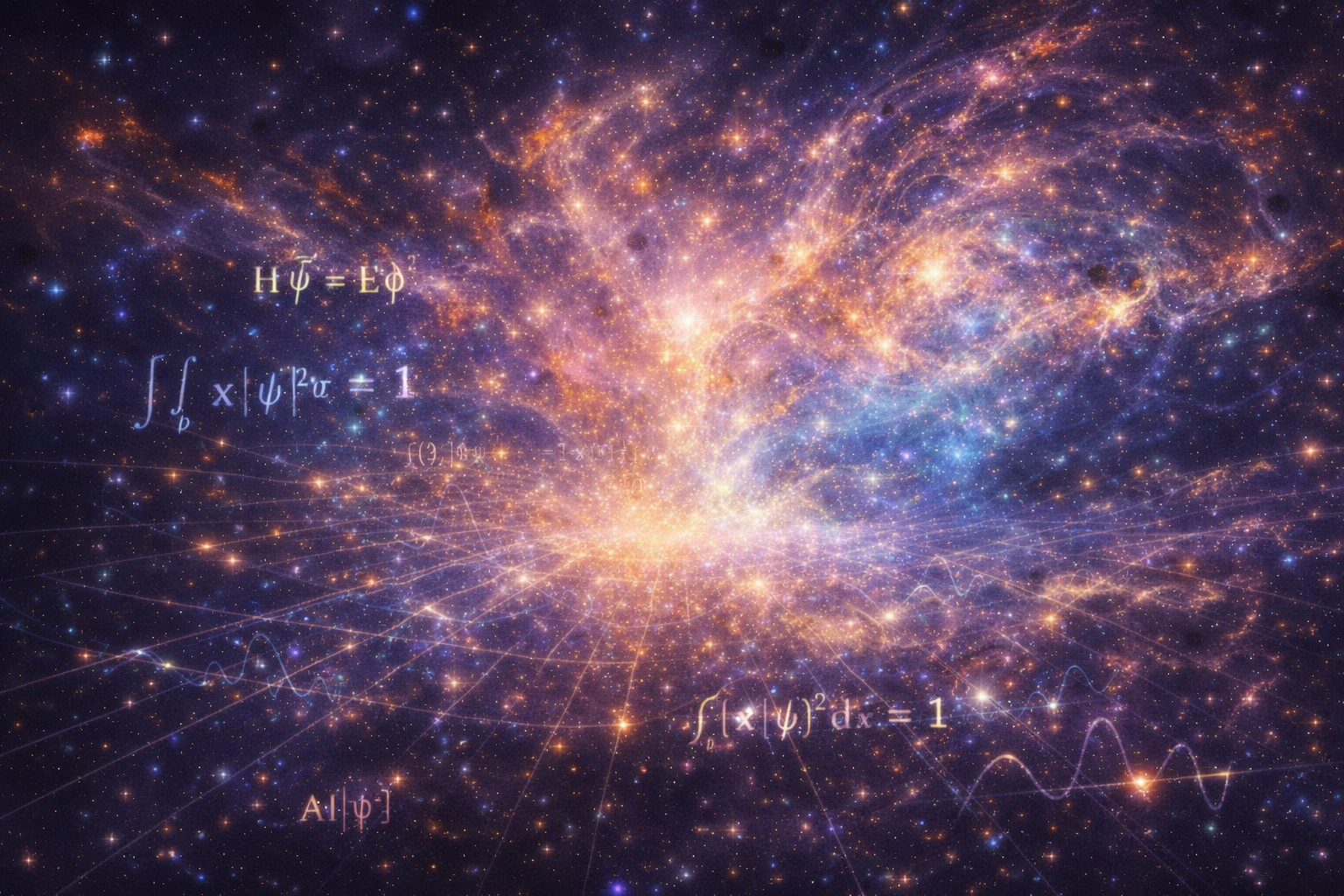
We can calculate outcomes with extraordinary accuracy. We can predict behavior with stunning precision. And yet, when we ask what is actually happening… the answers dissolve into mystery.
Introduction
Physics was supposed to explain reality.
To reveal what the world is made of.
To replace mystery with understanding.
And in many ways, it succeeded.
It gave us:
- laws
- equations
- predictive power
But then came quantum mechanics.
And instead of removing mystery…
It refined it.
The Success of Quantum Theory
Quantum mechanics is incredibly successful.
It predicts:
- atomic behavior
- chemical interactions
- technological systems
With precision that is almost unbelievable.
It works.
Perfectly.
And yet…
The Failure to Explain
When we ask:
What is actually happening?
The answers become unclear.
Is a particle:
- a wave?
- a particle?
- both?
- neither?
Does it:
- exist in one place?
- exist in many?
The theory does not commit.
The Dual Nature
Particles behave like waves.
Waves behave like particles.
Depending on:
how you observe them
This is not a limitation of measurement.
It is:
a fundamental feature
The Observer Problem
Observation plays a strange role.
It seems to:
- influence outcomes
- define states
But what is observation?
Is it:
- interaction?
- measurement?
- consciousness?
There is no single answer.
Multiple Interpretations
To make sense of this, physicists created interpretations:
- Copenhagen Interpretation
- Many Worlds
- QBism
- Pilot Wave Theory
Each one explains the math.
None agree on:
what reality is
The Map Without the Territory
Quantum mechanics gives us:
a perfect map
But it does not clearly reveal:
the territory
We know how things behave.
But not:
what they are
The End of Classical Intuition
Classical physics aligned with intuition.
Objects had:
- position
- momentum
- trajectory
Quantum mechanics breaks this.
It tells us:
reality does not behave the way we expect
The Collapse of Certainty
At the quantum level:
- certainty disappears
- probability dominates
- outcomes are not fixed
Reality becomes:
inherently uncertain
Not because of lack of knowledge—
But because:
uncertainty is built into it
The Edge of Understanding
This creates a boundary.
Up to a point, we can:
- calculate
- predict
- model
Beyond that, we encounter:
wonder
Not ignorance.
But something deeper.
Wonder as a Mode of Knowing
Wonder is not the absence of knowledge.
It is:
the recognition of its limits
The moment where:
Understanding works…
But explanation fails.
The Echo in Consciousness
This boundary feels familiar.
Because the same thing happens inwardly.
You can:
- analyze thoughts
- observe experience
- describe patterns
But when you ask:
“What is awareness itself?”
You reach:
the same edge
The Shift from Control to Curiosity
Quantum mechanics changes the relationship with reality.
From:
- controlling
- explaining
To:
- observing
- wondering
The Beauty of Not Knowing
There is a strange beauty here.
Because mystery is not a failure.
It is:
an invitation
To explore without needing to conclude.
Key Insight / Turning Point
Quantum mechanics shows that:
knowledge has limits
And beyond those limits…
There is not chaos.
There is:
mystery
Structured.
Consistent.
But not fully explainable.
Practices / Reflections
-
Sit with unanswered questions
Resist the urge to resolve everything -
Observe limits of thought
Notice where understanding stops -
Embrace curiosity
Let wonder remain open -
Feel the unknown
Experience not knowing directly
Closing
Physics still works.
Equations still predict.
Technology still functions.
But something has changed.
Reality no longer feels fully explainable.
It feels:
partially known
partially mysterious
And instead of trying to eliminate that mystery…
I’ve started to see it differently.
Not as a problem.
But as:
the edge of something deeper
Where knowledge ends…
And wonder begins.