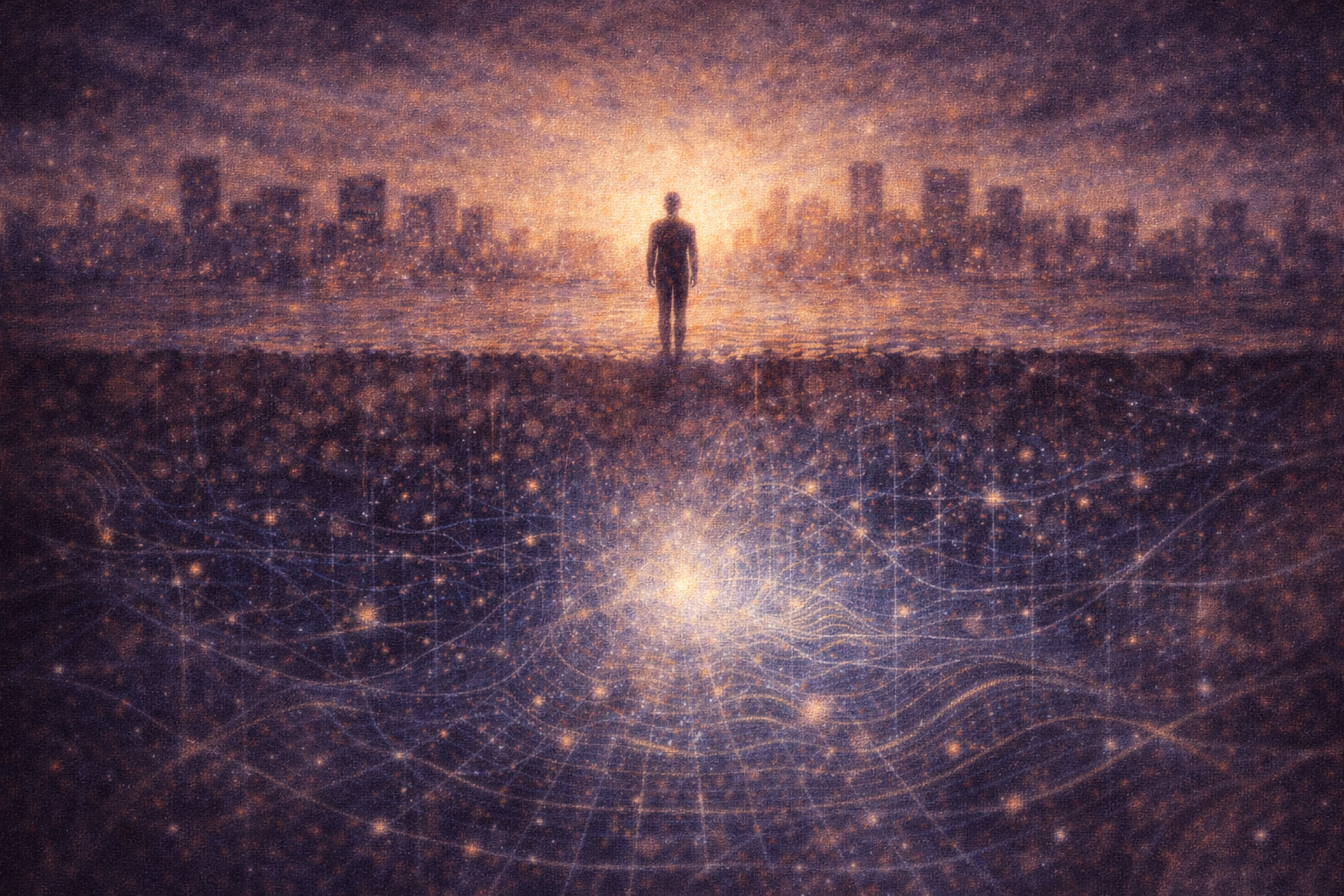
What you see, hear, and feel is not reality itself—but a filtered, compressed version designed for survival, not truth.
Introduction
It always feels like I’m seeing the world as it is.
Objects are solid.
Colors are real.
Sounds are direct.
The world appears complete.
Self-evident.
But that assumption began to crack the moment I asked a simple question:
What am I actually perceiving?
Not philosophically.
Literally.
The Narrow Window
My eyes detect only a tiny fraction of light.
What I call “visible light” is just a narrow band in a vast electromagnetic spectrum.
Beyond it:
- Infrared
- Ultraviolet
- Radio waves
- X-rays
All present.
All real.
All invisible to me.
So what I see is not reality.
It is:
a slice
The Silent World
The same is true for sound.
I hear only a limited range of frequencies.
Below it:
- infrasound
Above it:
- ultrasound
Entire layers of vibration exist beyond perception.
Creatures navigate using them.
Machines operate through them.
But for me:
they don’t exist experientially
The Brain as Filter
At first, this feels like a limitation.
But then a deeper realization emerges:
This is not a flaw.
It is:
a feature
The brain is not designed to show reality.
It is designed to:
simplify it
To:
- reduce complexity
- prioritize survival
- create a manageable interface
Reality as Interface
What I perceive is not raw reality.
It is:
- interpreted
- compressed
- reconstructed
Like a user interface.
Icons on a screen.
You don’t see:
- the circuits
- the code
- the electrical processes
You see:
symbols
Useful.
But not fundamental.
The Constructed World
Color is not “out there.”
It is:
a translation of wavelengths
Sound is not “out there.”
It is:
a translation of vibrations
Even solidity is not absolute.
Atoms are mostly empty space.
Yet I experience:
a solid world
The Invisible Depth
So beneath everything I experience…
There is:
- more information
- more structure
- more reality
But it is not directly accessible.
What I perceive is:
a surface rendering
The Comfort of the Interface
This realization can feel unsettling.
Because it means:
What I call “real” is:
incomplete
But it also explains something important.
Why the world feels:
- stable
- consistent
- understandable
Because it has been:
simplified
The Illusion of Completeness
The mind assumes:
“What I see is all there is.”
But that assumption is false.
Not because the world is hidden.
But because:
perception is limited by design
Beyond the Senses
Even beyond physical limits…
There are layers we don’t perceive:
- microscopic processes
- quantum interactions
- complex systems
Reality extends far beyond:
what can be sensed
The Shift in Perspective
At some point, something shifts.
You stop treating perception as truth.
And begin to see it as:
a model
A representation.
A useful illusion.
The Unknown Beneath Everything
This leads to a deeper humility.
If most of reality is invisible…
Then what I know is:
minimal
And what I don’t know is:
vast
Key Insight / Turning Point
Reality is not what appears.
What appears is:
a filtered version of reality
Designed for survival.
Not for truth.
Practices / Reflections
-
Question perception
Ask: “What am I not seeing?” -
Expand curiosity
Imagine layers beyond your senses -
Notice interpretation
See how the mind constructs experience -
Hold reality lightly
Recognize perception as partial
Closing
The world still looks the same.
Colors remain.
Sounds remain.
Objects remain.
But something has changed.
They no longer feel like:
the whole story
They feel like:
a surface
A thin layer over something vast.
Something mostly invisible.
And strangely…
That doesn’t make reality smaller.
It makes it:
infinitely deeper