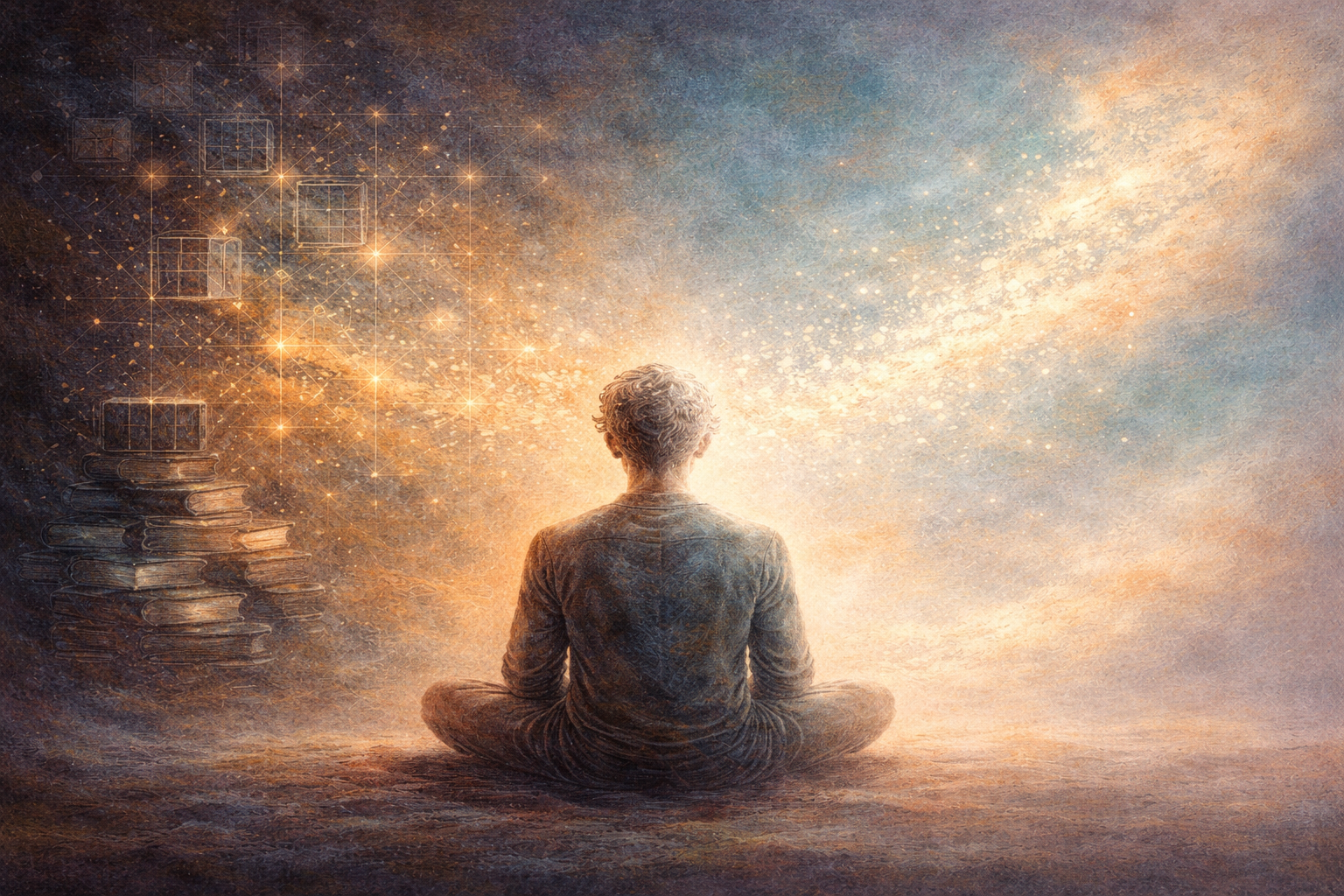
We climb the mountain of knowledge believing clarity waits at the peak—only to discover that the summit is a doorway into silence.
Introduction
There was a time when I believed knowledge was salvation.
Every book I read felt like progress. Every concept I understood felt like I was getting closer to something final—something solid, something real. I was building a map of reality, piece by piece, convinced that one day the map would be complete.
Physics gave me structure.
Philosophy gave me depth.
Neuroscience gave me mechanisms.
Spiritual texts gave me meaning.
It felt like assembling a grand puzzle.
But slowly, something unsettling began to happen.
The clearer my understanding became, the less stable everything felt.
The Climb
There is a strange intoxication in learning.
You begin to see patterns where there was once chaos. Words sharpen your perception. Concepts give you control. The unknown starts shrinking.
Vedanta calls this phase śravaṇa—the gathering of knowledge. It is necessary. It refines the intellect. It protects you from blind belief and superstition.
And for a while, it works beautifully.
You begin to understand the world:
- Matter is mostly empty space
- The self is constructed through memory and identity
- Time is not as linear as it feels
- Reality may not be as solid as it appears
Each insight feels like a victory.
But then comes the shift.
The Crack in the Map
At some point, the map starts betraying you.
The more precisely you define things, the more they dissolve.
“Matter” becomes probability.
“The self” becomes a process.
“Truth” becomes perspective-dependent.
Even your own identity starts to feel like a story being told rather than something fixed.
It’s like trying to grab water with your hands.
And then one night, sitting with all this knowledge, something became obvious:
Every concept I had learned was pointing to something it could not contain.
The map was never the territory.
When Knowledge Becomes Transparent
This is the turning point most people miss.
Knowledge doesn’t fail.
It becomes transparent.
You still use concepts, but you can see through them. Like glass. Like a UI overlay that no longer blocks the system beneath.
During meditation, this became directly visible:
- A “tree” was no longer a tree, just color and form
- A “thought” was just movement in awareness
- A “self” was just a pattern with no center
There was still experience—but no rigid structure holding it together.
This is what Zen calls beginner’s mind.
This is what Advaita points to when it says: neti, neti — not this, not that.
The Bridge Between Knowing and Not Knowing
If this process stops here, it can feel empty. Even destabilizing.
Because when everything dissolves, what remains?
This is where something unexpected appears:
Love.
Not as emotion, but as a way of being.
Love allows you to:
- Hold knowledge without clinging
- Let go without fear
- Exist without needing final answers
It is the soft ground beneath collapsing certainty.
In that space, knowing and unknowing are no longer opposites. They become complementary.
Key Insight / Turning Point
The goal of knowledge is not accumulation.
It is liberation from the need to know.
You climb the mountain not to stand at the top, but to realize:
There was never a top. Only a shift in perspective.
And when that shift happens, something quiet but profound emerges:
You stop trying to possess truth…
And allow yourself to be shaped by it.
Practices / Reflections
-
Notice conceptual overlays
When you look at something, ask: “Am I seeing this, or just naming it?” -
Let knowledge dissolve in meditation
Sit quietly and watch how concepts arise and fall. Don’t hold them. -
Alternate between study and silence
Learn deeply. Then drop everything and just observe. -
Ask better questions
Instead of “What is truth?” try “What remains when I stop defining?”
Closing
Now I see knowledge differently.
It’s not a ladder to climb forever.
It’s a ladder you climb… and then gently step off.
Behind you is everything you’ve learned.
Ahead of you is something you cannot learn—only experience.
And in that open space, something strange happens:
You don’t feel like you’ve lost knowledge.
You feel like you’ve finally stopped mistaking it for reality.